How AI Is Changing Custom Web Design in 2026
See how AI is changing custom web design, website design and marketing, personalization, testing, and conversion paths for US businesses.
Read insight

phone
+1 (727) 297-4842
What is the difference between a Shopify theme and custom Shopify development? Compare cost, speed, flexibility, and which option fits US brands.
Quick Summary
A Shopify theme is a ready made store design you customize. Custom Shopify development builds the store experience around your brand, features, and conversion goals. Themes launch faster and cost less. Custom builds cost more and scale better when your store needs unique layouts, advanced logic, or stronger performance.
What is the difference between a Shopify theme and custom Shopify development? For many US business owners, this is the real decision behind every Shopify quote. One option looks faster and cheaper. The other looks more expensive but more tailored. Both can sell. They just solve different problems.
A theme based store starts with a prebuilt design and then gets branded, configured, and lightly customized. Custom Shopify development starts with your customer journey and builds the layouts, sections, and features around how you actually sell. This guide explains shopify theme vs custom development in plain terms so you can choose with confidence. If you are also budgeting the project, pair this with how much it costs to build a Shopify store before you compare proposals.
A Shopify theme is a ready made storefront design that already includes product pages, collection layouts, cart behavior, and common ecommerce sections. You buy or install the theme, then customize colors, fonts, logos, banners, and page content. Premium themes also include settings for menus, filters, and common merchandising blocks.
Theme based builds work well when your catalog is straightforward and your brand can fit inside a proven layout. Many successful US stores launch this way. The advantage is speed. You can get a professional looking store live without inventing every page from scratch. The limit is that the theme still has a structure you are adapting to, not a structure built only for your business.
Custom Shopify development means designing and coding store experiences around your brand and selling process. That can include unique homepage sections, tailored product page layouts, custom collection filters, subscription logic, advanced upsells, or performance focused theme code. In some projects it means heavy customization of a base theme. In others it means a fully custom theme built for one brand.
This path is for stores that need more than color changes and section toggles. If your product discovery is complex, your brand needs a distinct experience, or your conversion funnel needs precise control, custom work usually fits better. Strong Shopify development services help you decide how custom the build actually needs to be instead of overbuilding by default.
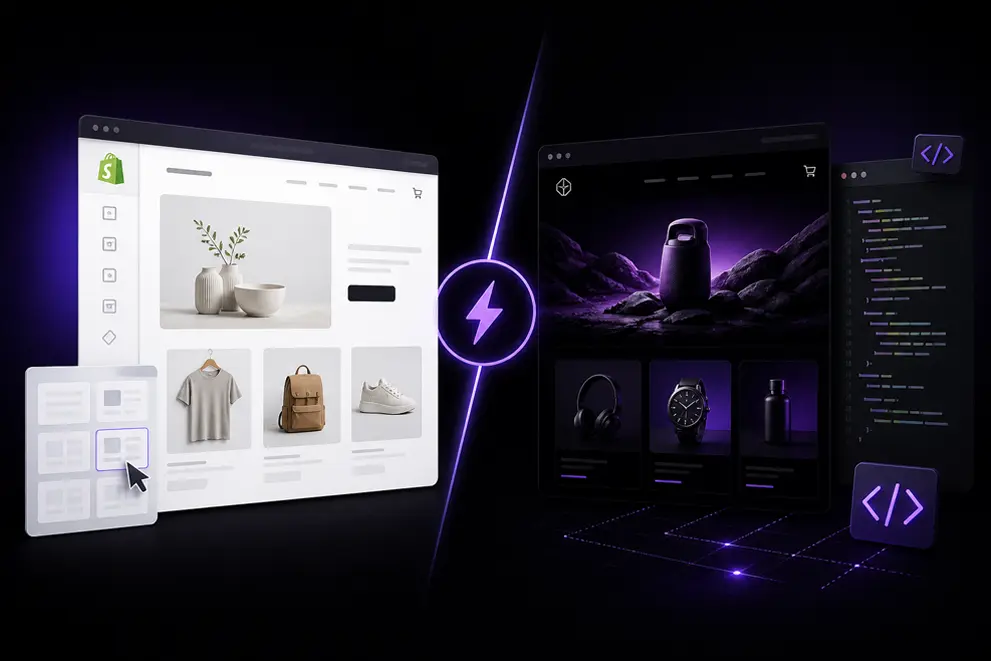
The biggest difference is ownership of the design system. With a theme, you start from someone else’s framework and bend it to your brand. With custom Shopify development, the framework is shaped around your buyers. That changes cost, timeline, flexibility, and how easy future changes will be.
Themes usually launch faster and cost less upfront. Custom builds take longer and cost more because design, development, and testing are more involved. Themes are easier for simple updates. Custom stores can support more advanced features, cleaner performance, and stronger brand differentiation. Neither option is automatically better. The better option is the one that matches your growth stage and selling complexity.
Choose a theme when you need to launch quickly, your product range is simple, and your budget is focused on getting sales started. A well chosen premium theme with thoughtful branding can convert well for many small businesses. This is especially true for single product brands, small catalogs, and first time Shopify launches.
A theme also makes sense when your team wants an easier admin experience and fewer moving parts. If most of what you need already exists in the theme settings, paying for a fully custom build can be unnecessary. In those cases, light shopify theme development and strong merchandising often deliver a better return than a complex custom project.
Custom work becomes worth it when the theme starts blocking growth. Common signs include awkward mobile layouts, limited product page control, slow page performance after stacking apps, or a brand experience that looks like every other store using the same theme. Growing catalogs and unique shopping journeys also push brands toward custom builds.
Custom Shopify development is also the better fit when conversion is the priority. If you need precise upsell placement, custom bundles, advanced filtering, or a checkout adjacent experience shaped around your offer, a theme alone may not get you there cleanly. Brands that also invest in SEO services for product and collection visibility often pair custom structure with search growth so the store ranks and converts as traffic increases.
Theme based stores usually cost less and launch sooner because much of the foundation already exists. Custom builds require more design and development hours, so both price and timeline rise. Maintenance also differs. Themes can break or feel limited after major Shopify updates or heavy app stacking. Custom code needs skilled support when features change, but it can stay cleaner if built well from the start.
This is why comparing quotes only by price is risky. One quote may cover theme setup and content entry. Another may include custom sections, performance work, and conversion testing. If you plan to hire a Shopify developer, ask what is theme configuration, what is custom code, and what will be hard to change later. Clear scope matters more than the cheapest number.
Many theme stores become slow because owners solve missing features with apps. Apps can be useful, but stacking too many of them often hurts speed and creates messy customer experiences. Custom development can reduce app dependence by building key features into the theme itself when those features are central to sales.
Conversion control is another practical difference. Themes give you settings. Custom builds give you more freedom to design the exact path from product discovery to checkout. That freedom only helps when it is used carefully. Extra features without a clear sales purpose just create cost. The goal is not custom for its own sake. The goal is a store that removes friction and supports buying decisions.
If your brand needs to feel premium, distinctive, or highly visual, a generic theme look can quietly hurt trust. Buyers notice when a store feels templated. Custom layouts, stronger visual hierarchy, and branded product storytelling can improve perceived quality. That does not always require a full custom theme, but it often requires more than default theme settings.
This is where design and development should work together. A strong visual direction without solid Shopify execution still fails at checkout. Likewise, clean code without brand presence can feel forgettable. For stores that need both, pairing custom build work with branding and identity design for ecommerce usually creates a more coherent buyer experience than choosing a theme and hoping logos alone will differentiate the brand.
Ask three questions. First, how unique does the shopping experience need to be for buyers to trust and choose you? Second, which features are must haves for sales in the next twelve months? Third, what budget and timeline are realistic without delaying launch too long?
If your answers point to speed, simplicity, and a standard catalog, start with a quality theme and professional setup. If your answers point to unique journeys, advanced merchandising, and long term control, invest in custom Shopify development. Many US brands also take a middle path: launch on a strong theme, then customize the pages that affect conversion most. When you are ready to decide with a clear scope, you can contact our team for a Shopify build recommendation based on your products, goals, and timeline.
The difference between a Shopify theme and custom Shopify development is not just technical. It is a business decision about speed, cost, uniqueness, and control. Themes help you launch efficiently inside a proven framework. Custom builds help you shape the store around the way your customers buy.
Pick the path that supports revenue, not the path that sounds more advanced. A clean theme store that converts is better than an overbuilt custom store that launches late. A custom store that removes friction is better than a theme that forces awkward workarounds. For brands ready to build with that clarity, professional custom Shopify development for US businesses can help you choose and execute the right level of customization.
A Shopify theme is a ready made store design you customize for branding and content. Custom Shopify development builds layouts, features, and conversion paths around how your business sells, which usually costs more but offers greater control and uniqueness.
Yes, for many small businesses a quality premium theme with professional setup is enough to launch and sell, especially with a simple catalog and a need for speed. Custom work becomes more valuable when the theme starts limiting conversion, branding, or required features.
Choose custom Shopify development when you need unique product journeys, advanced merchandising, stronger brand differentiation, better performance control, or features that would otherwise require stacking too many apps.
Not always. Some projects heavily customize a strong theme, while others need a fully custom theme. The right level depends on your catalog complexity, brand goals, timeline, and budget.
Theme based stores usually cost less and launch faster. Custom Shopify development costs more because it includes more design, coding, and testing, but it can return more value when uniqueness and conversion control matter to growth.
These articles support the same questions we solve across our main pages and services: ranking on Google, improving website performance, comparing channels, and generating better-fit leads.
See how AI is changing custom web design, website design and marketing, personalization, testing, and conversion paths for US businesses.
Read insightLearn how to convert social attention into enquiries and sales with trust content, offers, and clear conversion paths.
Read insightSee platform fees, agency pricing, marketing automation costs, and how US small businesses should budget email for ROI.
Read insightThe right agency should match your goals, communicate clearly, and connect marketing work to lead quality and business growth.
Read insightLet's Collaborate
