How AI Is Changing Custom Web Design in 2026
See how AI is changing custom web design, website design and marketing, personalization, testing, and conversion paths for US businesses.
Read insight

phone
+1 (727) 297-4842
Learn how to choose a digital marketing agency in the USA. Compare strategy, reporting, fit, pricing, and red flags before you hire your next growth partner.
Quick Summary
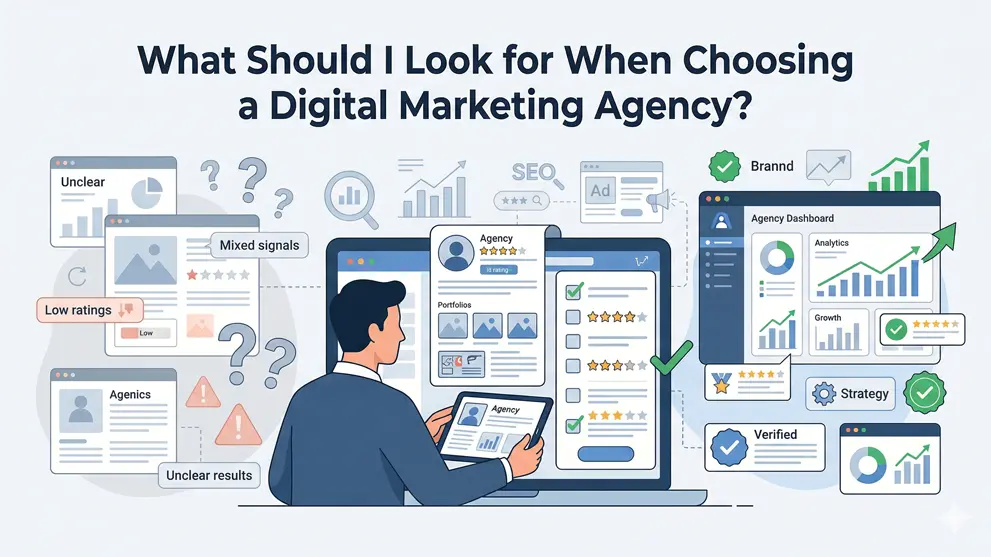
If you are asking how to choose a digital marketing agency, start by looking beyond promises and ask whether the agency understands your goals, can explain its strategy clearly, and can show how the work will improve leads, sales, and long term growth.
Choosing a digital marketing agency can feel overwhelming because many agencies sound similar on the surface. Almost all of them talk about growth, results, and strategy. The difference usually appears when you look at how they think, how they communicate, and how well they connect marketing work to your actual business goals. If you are trying to choose the right partner, the most useful question is not who sounds the most impressive. It is who can explain a realistic path from your current position to better visibility, stronger leads, and healthier revenue.
Many businesses phrase this search differently: how to choose digital marketing agency, how to select a digital marketing agency, or how to choose the right marketing agency. The evaluation standard is the same in each case: strategic fit, clarity, execution quality, and reporting that connects to business outcomes. If you are also comparing broader US market options, our guide to the best digital marketing agency in USA and how to choose breaks down what separates polished sales language from a genuinely strong partner.
That matters even more for businesses in the USA where competition is often high and marketing budgets need to be used carefully. A good agency should help you make better decisions across SEO, website performance, paid campaigns, content, and conversion paths. It should also help you understand whether the real problem is traffic, messaging, trust, page quality, or follow up. If the agency cannot diagnose the actual issue, the work can become expensive activity without meaningful progress.
If your team is deciding how to choose a digital marketing agency, use a simple sequence. First, define the business target: more qualified leads, better close rates, stronger local visibility, or improved retention. Second, review whether the agency can explain channel priorities across SEO, paid ads, content, and page experience. Third, validate reporting logic before signing so you know exactly how results will be measured.
When people ask what to look for in a marketing agency or what to look for in a digital marketing agency, the answer should not be generic. You should see a clear diagnosis of your situation, a practical first-stage plan, and realistic expectations tied to timeline and budget.
The first thing to look for when choosing a digital marketing agency is whether the agency understands your business problem clearly. Some businesses need more qualified leads. Others need better local visibility. Others may already have traffic but weak conversion rates. If the conversation starts with a generic service package before anyone has explored your goals, market, sales cycle, and website condition, that is usually a warning sign. Good agencies start by understanding what success should look like for your business.
This is important because not every company needs the same mix of services. A local service business may need stronger search visibility and landing page improvements. An ecommerce brand may need a different content and ad strategy. A business comparing channels may need clarity similar to the questions covered in SEO vs PPC for small businesses. A strong agency should be able to explain why a recommendation fits your goals instead of pushing a prebuilt offer that looks the same for every client.
Many agencies promise page one rankings, explosive growth, or guaranteed leads. Those promises often sound attractive because business owners naturally want certainty. The problem is that serious marketing work rarely operates on guarantees, especially in competitive American markets. Search visibility depends on competition, existing site quality, trust signals, offer strength, and time. Paid campaigns depend on budget, offer fit, landing page quality, and targeting. The right agency should speak with confidence, but it should also be realistic.
Clear thinking usually sounds different from sales language. It sounds specific. An agency should be able to explain what it sees on your site, what may be holding performance back, what should be prioritized first, and what results are reasonable over a given period. If your website has the kinds of problems discussed in Why Your Website Is Not Ranking, the agency should say so plainly. If the site needs better structure, content depth, or development support, those issues should not be hidden behind polished presentations.
Another thing to look for when choosing a digital marketing agency is relevant experience. That does not always mean the agency must have worked with your exact niche before, but it should understand the kind of buying journey your customers go through. A home services company, a B2B consultant, a law firm, and a local clinic all attract leads differently. Search intent is different. Trust signals are different. Conversion friction is different. The agency should show that it understands how those differences affect the strategy.
Relevant experience often appears in the way the agency asks questions. Does it ask about lead quality instead of just lead volume. Does it ask about average deal value, sales cycle length, and local competition. Does it talk about how your service pages, follow up process, and reporting tie together. These are stronger signs than broad claims about working with hundreds of industries. Useful experience helps the agency spot patterns faster and avoid spending months learning lessons that should have been obvious at the start.
Business owners often underestimate how important communication is when choosing a digital marketing agency. Even strong technical work can become frustrating if the agency is hard to reach, vague in updates, or inconsistent in explaining what it is doing. Good communication builds confidence because it helps you understand why certain priorities matter and what progress should look like. It also makes it easier to solve problems early instead of discovering confusion months later.
A useful agency should be able to explain strategy in plain language. It should help you understand what changed, what is next, and what decisions require your input. That does not mean every update needs to be long. It means the reporting and conversations should be clear enough that you can see the connection between work completed and business impact. If the agency hides behind jargon or avoids direct answers, the relationship can become difficult even if some work is technically correct.
One of the most practical things to look for when choosing a digital marketing agency is the quality of its reporting approach. Many agencies send dashboards full of clicks, impressions, and sessions without showing whether those numbers improved qualified leads or revenue opportunities. That kind of reporting may look busy, but it does not help you make better decisions. Strong reporting should connect visibility to action and action to results.
For example, if an agency is helping with Google visibility, it should help you see which pages are attracting the right traffic and which ones are converting. If it is managing paid campaigns, it should help you understand which search themes, locations, or landing pages are producing stronger leads. This is why businesses that care about sustainable growth often need connected analytics and reporting. An agency that cannot measure quality clearly will struggle to optimize quality consistently.
A common mistake in agency selection is assuming the channel is the whole solution. Some agencies focus heavily on ads, rankings, or content volume without paying enough attention to the destination page. In reality, a weak website can reduce the value of every channel. If the site is unclear, slow, outdated, or poorly structured, the business may receive traffic without enough trust or conversion. That is why it is valuable when an agency talks about page quality and user experience as part of the plan.
A thoughtful agency should look at how the website supports the journey from search to enquiry. That includes page speed, service clarity, internal linking, calls to action, trust signals, and mobile usability. If the site needs stronger page architecture or cleaner templates, the agency should say so and explain how web development support could improve outcomes. Businesses that want more leads from Google often discover that better pages matter just as much as better rankings, which is also reflected in our guide on how to get leads from Google.
One of the best signs when choosing a digital marketing agency is honesty about fit. A good agency does not need to say yes to every project. Sometimes the budget is not large enough for the goal. Sometimes the site needs foundational work before aggressive marketing makes sense. Sometimes the business needs help with positioning, operations, or sales follow up before more traffic will create value. An agency that can say these things honestly is usually more trustworthy than one that accepts everything without challenge.
That honesty also shows up in timing. If SEO will take time, the agency should explain that. If paid campaigns can deliver faster feedback, it should explain that too. If a combined plan is more realistic than a single channel, that should be part of the recommendation. Honest fit conversations create better outcomes because they reduce the gap between expectation and execution. They also help you choose a partner that is thinking about business health, not just contract size.
When you are close to making a decision, it helps to ask a simple question: if this engagement works well, what will success look like in three months, six months, and beyond. A professional agency should be able to answer that in a way that feels grounded. It may talk about better search visibility, improved page quality, stronger lead tracking, or more qualified enquiries. The important thing is that the answer reflects a realistic path rather than a vague promise.
You should also ask what the first stage of work would involve. A good answer might include audit findings, page priorities, tracking improvements, campaign testing, or content planning. It should sound like a sequence, not a mystery. If you want to explore whether your business is a fit for this kind of support, the next step should be simple and clear through the contact page for a strategy conversation. Clear next steps are often a strong signal that the agency is organized and understands how to move from diagnosis to execution.
Choosing a digital marketing agency is less about finding the loudest promise and more about finding the clearest fit. The right partner should understand your business goals, explain its thinking honestly, communicate well, and show how the work will improve meaningful outcomes such as qualified leads, better visibility, and stronger conversion paths. It should also be comfortable telling you when something on the site or in the offer needs attention before more traffic will help.
If you evaluate agencies through that lens, the process becomes much simpler. You stop comparing polished language and start comparing clarity, relevance, trust, and execution quality. That usually leads to a better partnership and a better return on your marketing investment over time.
A strong fit comes from shared goals, clear communication, relevant SEO and web experience, realistic planning, and reporting that connects marketing work to qualified leads and revenue in your market.
Not always. The better choice solves your actual growth problem well, whether that requires SEO, PPC, web development, content marketing, or a connected mix of services.
Look for clear goals, channel priorities, timelines, reporting, website and SEO understanding, and how the agency will measure qualified leads—not vanity metrics alone.
Even strong SEO or PPC fails when the site is slow, unclear, or hard to convert. Agencies that understand web development and conversion design usually produce better long-term results.
These articles support the same questions we solve across our main pages and services: ranking on Google, improving website performance, comparing channels, and generating better-fit leads.
See how AI is changing custom web design, website design and marketing, personalization, testing, and conversion paths for US businesses.
Read insightSee when social media management pays off for US small businesses and how to measure ROI beyond likes and follower count.
Read insightSee platform fees, agency pricing, marketing automation costs, and how US small businesses should budget email for ROI.
Read insightCompare digital marketing agencies in the United States by strategy, communication, page quality, and lead focused reporting.
Read insightLet's Collaborate
