How to Turn Social Media Followers into Paying Customers
Learn how to convert social attention into enquiries and sales with trust content, offers, and clear conversion paths.
Read insight

phone
+1 (727) 297-4842
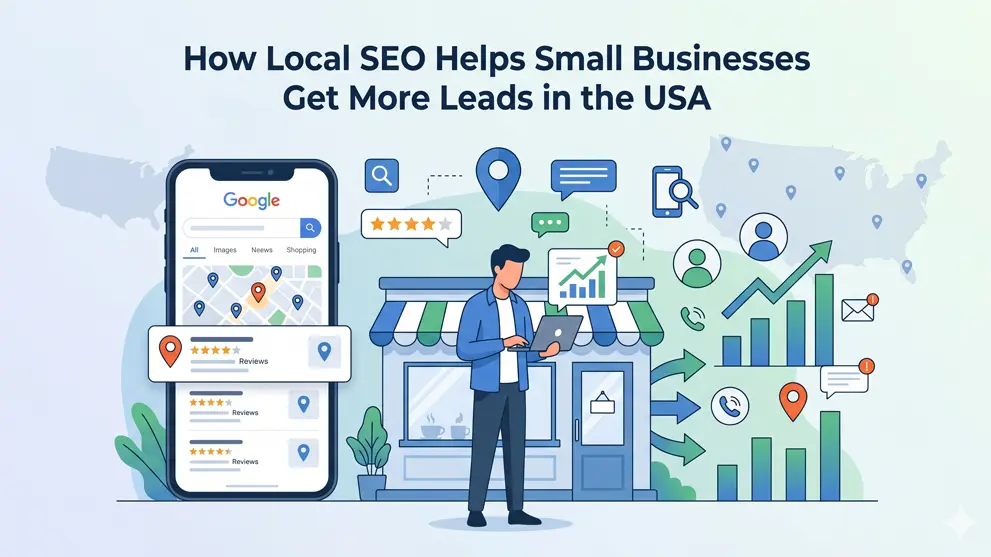
See how local SEO helps small businesses in the USA get more leads through Google Maps, reviews, location pages, and trust signals that drive calls.
Quick Summary
Local SEO for small business growth works when Google Business Profile optimization, local landing pages, reviews, and conversion design all support the same city level intent. More visibility matters, but more qualified local enquiries matter more.
How local SEO helps small businesses get more leads in the USA comes down to one basic idea: showing up for nearby buyers at the exact moment they need a service. A person searching for a roofer in Dallas, a dentist in Phoenix, or an accountant in Columbus is not browsing casually. That person usually has a need, a location, and a short list of businesses to compare. Local SEO for small business growth makes sure your company has a real chance to be one of those options. When that visibility is supported by strong local pages, reviews, and a clear next step, search traffic turns into calls, form fills, and booked appointments.
This is why services local SEO work best when they are treated as a lead system instead of a checklist. A business may improve map visibility and still miss leads if the website feels weak, the contact path is confusing, or the local page does not match the search. Strong local SEO combines Google Business Profile, city relevance, trust signals, and page quality. Businesses that want broader context can also review how small businesses in the USA can rank on Google because local SEO is often the most practical part of that larger search strategy.
One reason local SEO near me searches are so valuable is that they often reflect immediate action. Users who include a city, neighborhood, or near me phrase are usually closer to choosing than users making a broad informational search. A small business does not need to outrank the entire country to win those leads. It needs to be relevant in the places it actually serves. That is why local SEO can outperform broader campaigns for many service businesses, especially when the business operates in one metro area or a focused group of nearby cities.
In practical terms, local intent shortens the path between discovery and enquiry. Someone searching for a local provider often checks the map pack, reviews, website clarity, and contact options within minutes. That means lead generation depends on being visible and believable at the same time. A business that understands this can organize its pages and profile around the real local buying journey instead of chasing broad traffic that never converts.
For many small businesses, the first local lead interaction does not happen on the website. It happens on the Google Business Profile. Users may call directly, ask for directions, read reviews, or view photos before they ever click through. That is why profile quality affects lead flow more than many owners realize. A complete profile with accurate categories, services, hours, descriptions, and strong recent reviews gives buyers confidence quickly. An incomplete or outdated profile creates doubt before the sales conversation even begins.
Profile optimization also supports ranking logic. Google needs clear relevance and prominence signals to decide which businesses should appear for location based searches. Categories, review volume, review quality, service alignment, and activity all help shape that confidence. This is a good example of why local SEO is not only a website task. The profile is part of the funnel, and it can be one of the strongest sources of leads when managed consistently.
Getting visible in local search is only half the job. The other half is converting that interest into a real enquiry. This usually happens on local service pages that explain what the business does, where it works, who it helps, and why someone should choose it. Thin city pages rarely do this well. A strong page speaks in buyer language, answers common concerns, and makes the next step obvious. It should feel useful to a person in that market, not copied from a template with only the city name swapped.
For example, a local SEO page for a service business in Chicago should not only mention Chicago. It should reflect the kind of customer problems, local trust cues, and service expectations that matter in that market. The same principle applies whether the business serves one city or a group of metro areas. This is where web development support for stronger local pages often helps because layout, speed, and page clarity all affect whether local traffic turns into leads.
Reviews are one of the clearest reasons best local SEO in USA style campaigns produce leads rather than empty clicks. Searchers compare not only who appears, but who feels safe to contact. A business with current, specific, believable reviews usually gets more calls than a business with thin or outdated review profiles. Reviews help in two ways. They improve local trust for the user, and they reinforce quality signals for Google.
The strongest review strategy is not just about volume. It is about relevance and recency. A review that mentions the actual service, city, or outcome is more persuasive than a vague compliment. When reviews are supported by good site copy, visible contact details, and clean branding, the local lead journey becomes smoother. This is one reason local SEO should be coordinated with branding, page messaging, and follow up rather than handled as a narrow ranking project.
Many small businesses publish a local page and expect it to perform on its own. In reality, internal linking often determines whether that page gains enough support to rank and convert. When a website links naturally from relevant blogs, service pages, and supporting sections, Google can understand how the topic fits into the site. Visitors also get a better experience because they can move from research to decision without getting lost.
That is why local pages should connect to helpful articles and core services. Someone researching local visibility may also want to understand how to get leads from Google, why a page may be underperforming, or what SEO support actually includes. Internal links turn the site into a trust path instead of a dead end. They also help the business build topical authority around local search instead of publishing isolated pages that never reinforce each other.
A lot of businesses assume rankings alone will fix lead generation. That is rarely true. If a page ranks and still does not produce enquiries, the problem is usually in the conversion path. Weak calls to action, buried contact forms, generic trust messaging, and poor mobile usability can all reduce local lead volume. In the USA, a large share of local search activity happens on mobile devices, which means speed, clarity, tap targets, and visible contact options matter a great deal.
Strong local SEO should make it easy for a buyer to move from interest to action. That can mean a clear quote form, a visible phone button, concise FAQs, city specific trust points, and a page structure that answers the next question before the user leaves. Businesses that connect SEO with user experience often outperform competitors that focus only on ranking position. This is also why local SEO should be measured against calls, booked consultations, and qualified forms, not only impressions or clicks.
Some owners assume local SEO only works for businesses with a storefront. That is not accurate. Service area businesses can also generate strong lead flow if their profile, service areas, and website structure support local relevance clearly. Plumbers, contractors, consultants, agencies, and many other businesses often serve multiple nearby cities while operating from a single base. The key is to show genuine relevance to each area rather than mass producing thin location pages.
A service area strategy works best when the business is realistic about where it can compete and where it can deliver well. Local SEO should support actual operations, not fantasy coverage. Pages need to make sense, reviews need to reflect real work, and service claims need to be consistent across the site and profile. When those pieces are aligned, service area businesses can compete effectively for local lead opportunities without needing a retail location in every city.
Top local SEO performance should be measured by business outcomes, not vanity metrics. Better map views are useful. More calls from qualified local buyers are better. Higher impressions may look impressive, but they do not mean much if the leads are poor or the service areas are wrong. The right reporting should show which pages, keywords, and locations are producing real enquiries and where the friction is happening after the click.
Small businesses should review call quality, form quality, booked appointments, and geographic patterns. They should also study whether one city page outperforms another, whether reviews improved conversion rates, and whether mobile users are reaching contact points easily. Strong analytics and reporting for local lead performance make this possible. Without that visibility, local SEO can look busy while hiding weak lead quality underneath.
Many small businesses see early local SEO movement within a few months, but stronger lead flow usually follows consistent Google Business Profile, review, page, and internal-link improvements.
No. Service-area businesses can win local search visibility when service pages, reviews, schema markup, and Google Business Profile signals clearly support local intent.
Optimizing Google Business Profile, building location and service pages, earning reviews, fixing technical SEO, and strengthening internal links usually move local lead generation faster than generic blogging alone.
Yes. Service-area businesses can rank locally when pages, profiles, and content clearly show where they operate and why searchers should trust them.
These articles support the same questions we solve across our main pages and services: ranking on Google, improving website performance, comparing channels, and generating better-fit leads.
Learn how to convert social attention into enquiries and sales with trust content, offers, and clear conversion paths.
Read insightSee platform fees, agency pricing, marketing automation costs, and how US small businesses should budget email for ROI.
Read insightGoogle lead generation works when visibility, trust, and conversion design are treated as one system instead of separate marketing tasks.
Read insightSee how AI is changing custom web design, website design and marketing, personalization, testing, and conversion paths for US businesses.
Read insightLet's Collaborate
